
From 17th-century sleeve fastenings to the quiet luxury of modern formal menswear — here’s the surprisingly fascinating story of one of the most enduring accessories in men’s style history.

Let’s talk about cufflinks.
Not in a stuffy, dress-code kind of way — but in the way you’d talk about a really good watch, or a perfectly broken-in leather belt. Cufflinks are one of those small things that, once you start paying attention to them, you can’t stop noticing. On the right shirt, at the right moment, they say everything without saying a word.
And here’s what’s easy to miss: these little accessories carry nearly 400 years of history on their backs. The history of cufflinks stretches from the gilded courts of 17th-century France all the way through Hollywood’s golden age, the power-dressing boardrooms of the 80s, and into today’s world of quiet, considered luxury. That’s a lot of ground for something that fits in your palm.
So whether you already own a few pairs or you’re just starting to explore the world of French cuffs, here’s everything you need to know.
Cufflink Origins: It All Started in 17th-Century France
If you want to find the cufflink origins, you have to go back to a time when the shirt was the star of the show.
In the 1600s, aristocratic men wore wide, flowing linen sleeves that needed to be closed at the wrist. For everyday folks, a simple button or ribbon did the job. But for men with wealth and a flair for standing out? They wanted something more interesting.
Enter the earliest cufflinks — small jeweled or enameled buttons, connected by a short chain or wire, threaded through buttonholes on each side of the cuff. They weren’t just functional. They were a flex. Crafted from gold, set with precious stones, and worn with the same deliberateness as a signet ring, these early sleeve fastenings were about status as much as style.
By the late 1600s, the trend had caught on across England and the rest of fashionable Europe. French cuffs — the folded, double-layer cuff that needs a separate fastening — became the mark of a well-dressed man. Sound familiar? That tradition is still very much alive today.
The 18th and 19th Centuries: Craftsmanship, Sentiment, and the Victorian Jewel
Through the 1700s, the cufflink quietly became a canvas for some seriously impressive craftsmanship. Goldsmiths and silversmiths across London, Paris, and Vienna were competing to outdo each other with miniature painted portraits on ivory, intricate engine-turned metalwork, and detailed enamel inlay. These were tiny, wearable works of art.
Then came the 19th century, and things got even more interesting.
Victorian jewelry culture was all about meaning. Men wore cufflinks engraved with family crests, set with mourning stones, or crafted to carry a tiny portrait of someone they loved. These weren’t just accessories — they were heirlooms with real emotional weight. If you’ve ever come across a pair of antique cufflinks in a relative’s belongings, you’ve experienced that firsthand.
At the same time, the industrial revolution was making cufflinks more accessible. For the first time, a well-made pair wasn’t just for the aristocracy — it was something any respectable professional could own. The cufflink became a symbol of ambition just as much as it was one of heritage.
It was also during this era that the modern swivel-back closure was patented — the same toggle mechanism you’ll find on most cufflinks today. Practical and elegant. A good combination then, and still a good one now.
The Edwardian Era Through the Jazz Age: Clean Lines and Cool Confidence
By the early 1900s, fashion had shifted. The ornate Victorian look was giving way to something cooler and more restrained. Edwardian men favoured sleeker silhouettes, and their cufflinks followed suit — cleaner profiles, platinum and white gold settings, stones in sapphire and aquamarine rather than heavy coloured gems.
Then the 1920s arrived, and everything got a little more exciting. Art Deco brought geometry into everything — architecture, furniture, fashion, and yes, cufflinks. Stepped rectangles, bold hexagons, sharp diagonal lines. Enamel in black and white. Gold paired with onyx. These were formal menswear accessories with an edge, and the men wearing them knew it.
It’s worth noting that style icons like the Duke of Windsor were quietly setting the standard during this period — wearing cufflinks with the kind of easy confidence that made them feel completely natural. Not like a special occasion accessory, but like something that simply belonged.
Post-War Elegance to the ’80s Boardroom: Cufflinks Get Serious
After World War II, men returned to offices, and the double-cuffed shirt made a strong comeback. In the 1950s and 60s, formal menswear accessories were standard issue for any self-respecting professional. Wearing a French cuffed shirt without cufflinks would have been a bit like turning up to a meeting without a tie — technically possible, but definitely noticed.
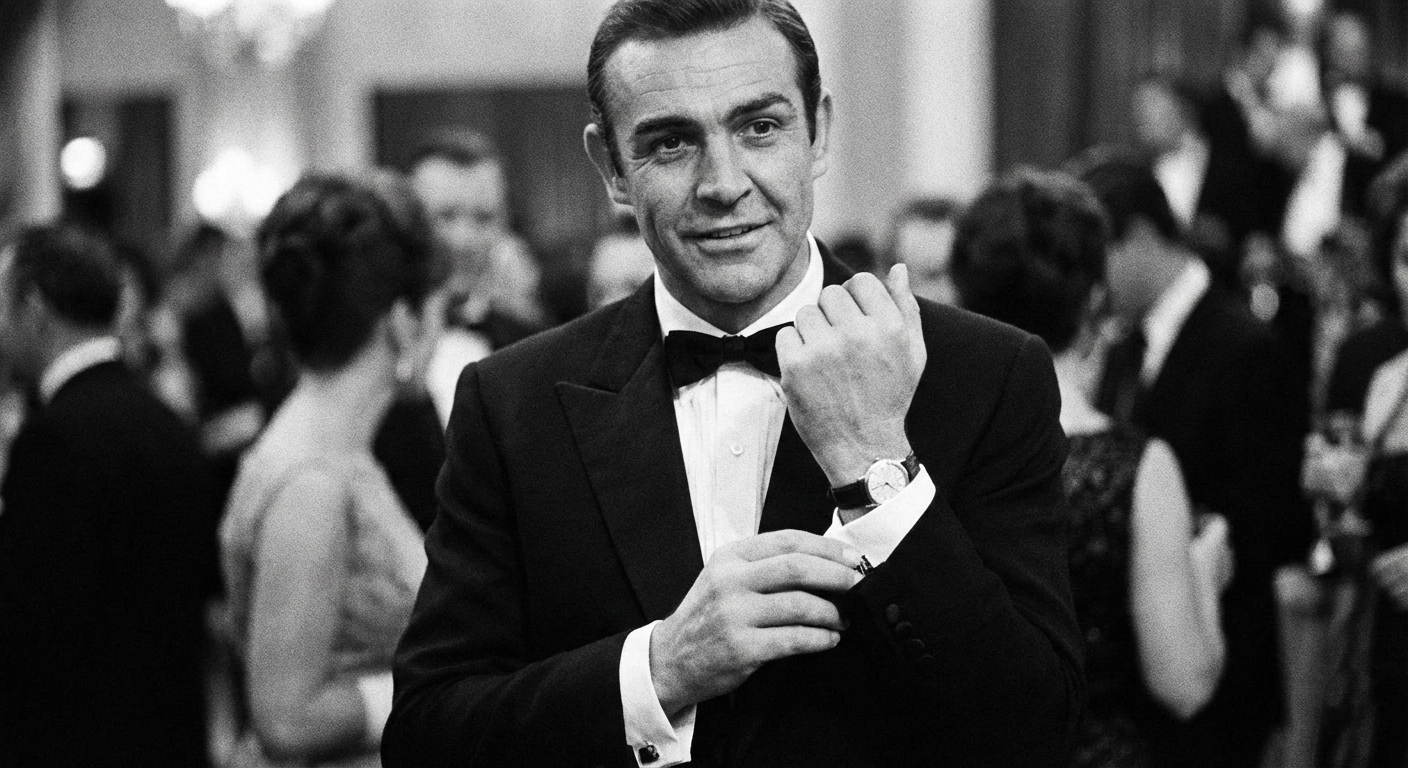
Hollywood did its part, too. Cary Grant, Frank Sinatra, Sean Connery as James Bond — these were men who made cufflinks look effortless. A flash of gold at the wrist while reaching for a glass, a clean silver face peeking out from under a tuxedo jacket. The cufflink became part of the visual vocabulary of masculine authority.
By the 1970s and 80s, power dressing pushed things in a bolder direction — bigger, brasher, louder. Oversized gold links, novelty shapes, statement stones. For some men, the cufflink became more about personality than polish. That spirit hasn’t entirely disappeared, and honestly, there’s still a place for it.
The Modern Evolution of Cufflinks: Less Is More (and More Considered)
Here’s where the evolution of cufflinks gets genuinely interesting for those of us dressing today.
When Silicon Valley started making open collars and sneakers acceptable in nearly every professional context, some people assumed the cufflink was finished. It wasn’t. If anything, choosing to wear cufflinks now carries more meaning than it ever did — because it’s a choice, not a requirement.
Today’s best cufflink designs tend to be beautifully restrained. Brushed sterling silver. Simple geometric shapes. Subtle textures and clean monograms. The history of cufflinks has always moved in cycles between ornament and simplicity, and right now, simplicity is winning — and winning well.
What’s exciting is that the craftsmanship behind those understated designs is anything but simple. Artisanal makers and heritage houses have returned to hand-finishing techniques that would feel familiar to a 17th-century court jeweler. The form has changed. The care hasn’t.
What the History of Cufflinks Actually Tells Us About Wearing Them
All of this history points to something pretty simple: cufflinks have always been about intention.
They’ve never been strictly necessary. Even when French cuffs were at their most fashionable, you could always just roll your sleeves up. But the men who wore cufflinks chose to — because they understood that the details are where the real story gets told.
That’s as true now as it was in the 1600s. Whether you’re wearing a pair of inherited gold ovals to a wedding, a set of brushed silver knots that you reach for every time you have an important meeting, or some enamel faces that just make you smile when you put them on — the best cufflinks are the ones that mean something to you.
Men’s style history is full of accessories that came and went. The cufflink stayed — because it was never just decorative. It was always personal.
A Small Object with a Long Story — and a Lot Left to Tell
Few accessories pack as much history into such a small package. From the jeweled sleeve fastenings of the French court to the matte-finish minimalism of today’s luxury ateliers, the cufflink has always been more than functional — it’s been a reflection of how men want to be seen.
And in an age where getting dressed has never been more casual, there’s something genuinely appealing about an accessory that asks you to slow down and pay attention. To fold the cuff. To choose the link. To notice the finish and what it says.
The history of cufflinks is really the history of men who believed that how you show up matters. We’re inclined to agree — and we think you might be, too.