Your 30s are a turning point — not just in life, but in how you dress. The trial-and-error experimentation of your 20s has given you some data to work with. You know a little more about who you are, what you do, and how you want to show up. Now it’s time to translate that self-awareness into a wardrobe that actually reflects it.
Dressing well in your 30s isn’t about spending more money or abandoning everything you wore before. It’s about being more intentional — buying better, wearing smarter, and building a closet that works as hard as you do. This guide covers exactly how to dress in your 30s as a man, from the mindset shift to the specific pieces worth investing in.
The Mindset Shift: From Quantity to Quality
If your 20s were defined by buying a lot and spending a little, your 30s are the decade to flip that equation. The fast fashion haul mentality — picking up ten mediocre pieces for the price of one good one — tends to leave you with a full wardrobe and nothing to wear. Pieces that don’t fit well, don’t hold up after washing, and don’t actually reflect your taste accumulate fast and do nothing for your appearance or your confidence.
The shift to quality over quantity is the single most important style upgrade you can make in your 30s. Fewer, better things. Pieces that fit properly, are made from decent materials, and will still look good in three years. This doesn’t require a luxury budget — it requires a more discerning eye and a willingness to wait for the right piece rather than settling for the convenient one.
Get Serious About Fit
If there’s one non-negotiable at any age, it’s fit — and your 30s are the decade to stop tolerating clothes that don’t fit properly. Shirts that balloon at the torso, trousers that sag in the seat, jackets with shoulder seams that droop onto the arm: these details undermine even the most carefully considered outfit.
Your body may have changed since your 20s. That’s not a problem — it’s just information. Get your measurements taken, reassess which cuts and silhouettes work best for your current proportions, and stop buying clothes in the hope that they’ll fit better once you lose or gain a few pounds. Dress the body you have now.
Find a reliable local tailor if you haven’t already. Off-the-rack clothes are made for an average that fits almost nobody perfectly, but a few well-chosen alterations — taking in a jacket waist, tapering trouser legs, shortening a shirt hem — can make an affordable garment look like it was made for you.
Build Around a Core Wardrobe
Your 30s are the ideal time to establish a core wardrobe — a set of versatile, well-made essentials that form the backbone of how you dress every day. Everything else you own should complement this foundation rather than compete with it.
A solid core wardrobe for a man in his 30s typically includes the following:
A well-fitted suit in navy or charcoal is the cornerstone of formal dressing. You don’t need a dozen suits — one or two excellent ones will serve you far better than five mediocre ones. Choose a classic cut that won’t feel dated in five years.
Two or three quality dress shirts in white, light blue, and a subtle pattern provide the coverage you need for formal and business occasions. These should fit well through the chest and shoulders and be made from decent cotton that holds up to regular wear and washing.
A blazer or sport coat in navy or grey bridges the gap between smart casual and business casual with ease. Pair it with chinos for work or a casual dinner, or over a roll-neck for a sharp off-duty look.
Five or six quality T-shirts in neutral tones — white, grey, navy, black — form the foundation of casual dressing. Invest in weight and fabric here. A heavyweight cotton T-shirt in a proper fit looks considerably more put-together than a thin, boxy one.
Two or three pairs of well-fitted chinos and one or two pairs of dark-wash jeans cover most casual situations. At this point in life, jeans should be clean, well-fitted, and worn with footwear that elevates rather than undermines them.
Quality footwear in three categories covers most situations: a pair of leather Oxford or Derby shoes for formal occasions, a clean leather or suede loafer for smart casual, and a minimal leather or white sneaker for casual days.
Elevate Your Casual Dressing
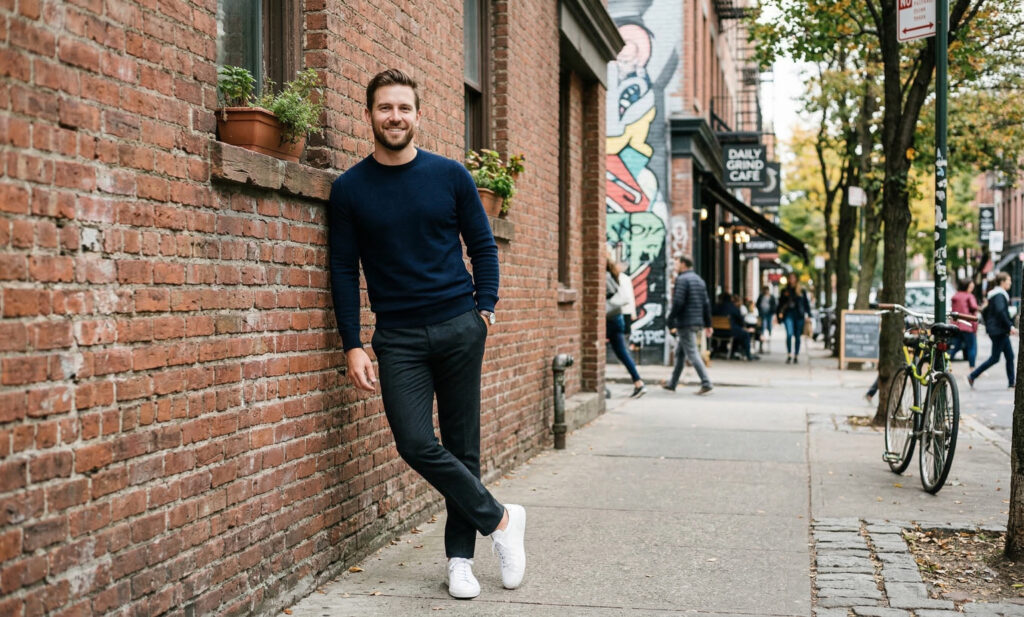
One of the most common style pitfalls for men in their 30s is continuing to dress casually the way they did at 22 — oversized graphic tees, baggy joggers, beat-up trainers — without any of the intentionality that makes casual dressing look considered rather than accidental.
Casual doesn’t mean low-effort. It means relaxed. There’s a meaningful difference between a man who throws on whatever’s closest and a man who wears a well-fitted OCBD shirt untucked with clean chinos and simple white sneakers. Both are casual. Only one looks like he’s paying attention.
In your 30s, elevate your casual dressing by focusing on fit, fabric, and footwear. Swap graphic tees for plain, high-quality ones. Replace worn trainers with a cleaner, more minimal sneaker. Introduce a few pieces — a decent overshirt, a well-cut polo, a quality merino crewneck — that add polish without sacrificing comfort.
Invest in Outerwear
Outerwear is one of the most visible elements of your appearance for a significant portion of the year, and it’s an area where men in their 30s are well-served by a genuine investment. A great coat does more for a first impression than almost anything else you wear.
The pieces most worth investing in are a classic overcoat in camel, navy, or charcoal — which works across almost every level of dressing from formal to smart casual — and a quality casual jacket such as a leather bomber, a well-made field jacket, or a wool-rich mac. These are pieces that will last years and look better as they age, provided they’re made from decent materials.
Avoid cheaply constructed outerwear. The lining frays, the shape collapses, and synthetic fabrics look thin and unconvincing within a season or two. With coats and jackets, buying once and buying well is the only approach that makes long-term sense.
Pay Attention to the Details
Style at any age lives in the details, and your 30s are the time to start paying attention to them. This means keeping shoes polished and resoled rather than replacing them when they scuff. It means ironing or steaming shirts before wearing them. It means wearing a watch, a simple leather belt, or a pocket square not as an afterthought but as a conscious finishing touch.
Grooming is part of the picture too. A well-dressed man with unkempt hair and neglected skin undermines his own effort. A consistent grooming routine — good skincare, a reliable haircut, neat nails — reinforces the intentionality of the rest of your appearance.
Small details signal whether someone is paying attention. Once you start noticing them in others, you’ll understand why they matter so much.
Let Go of What No Longer Serves You
Your 30s are also a decade of editing. Not every piece you loved at 24 belongs in your wardrobe now — and holding onto items that no longer fit your body, your lifestyle, or your aesthetic out of nostalgia or guilt just creates clutter and indecision.
Do a wardrobe audit. Pull out everything you haven’t worn in a year and be honest about why. If it doesn’t fit, donate or sell it. If it no longer reflects how you want to dress, let it go. A smaller, well-edited wardrobe of things you genuinely wear and love is infinitely more useful than a packed rail of things that “might come in handy.”
For practical guidance on building and editing a wardrobe at this stage of life, Mr Porter’s style journal offers well-produced, practical menswear advice that’s genuinely useful for men navigating this style transition.
Final Thoughts
Dressing well in your 30s is less about following rules and more about developing a point of view. Know what works for your body and your life. Invest in quality where it counts. Wear things that fit. Pay attention to the details. Edit ruthlessly.
The result isn’t a more expensive wardrobe — it’s a more considered one. And that, more than any individual piece or trend, is what separates a man who dresses with intention from one who simply gets dressed.