No single upgrade transforms a man’s appearance more dramatically than proper fit. You can spend a fortune on designer labels or keep your wardrobe entirely high street — but if the clothes don’t fit, neither will land the way you intend. Conversely, a well-fitted affordable outfit will consistently outperform an expensive one that hangs, bunches, or pulls in the wrong places.
Understanding how clothes should fit men isn’t about chasing a particular body type or conforming to someone else’s idea of how you should look. It’s about making the most of your own proportions so that every piece you wear looks intentional, polished, and effortlessly put-together.
This guide covers every wardrobe staple — from suits and dress shirts to chinos and jeans — so you always know exactly what good fit looks like.
Why Fit Is Everything
Before getting into the specifics, it’s worth understanding why fit matters so much. Clothing is essentially a frame for your body. When it fits well, it creates clean lines, balanced proportions, and a silhouette that looks deliberate. When it doesn’t, even the most beautiful fabric or cut can look sloppy.
The good news is that fit is fixable. A tailor can transform an off-the-rack purchase into something that looks custom-made for a fraction of the cost of bespoke. Learning what good fit looks like is the first step — and once you know what to look for, you’ll never unsee it.
How a Suit Should Fit
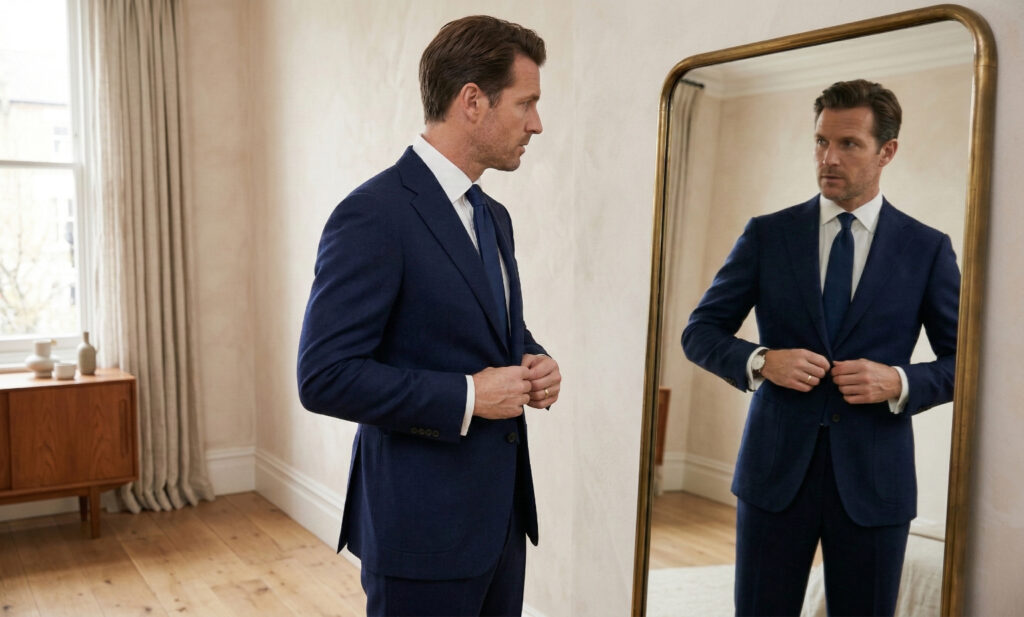
The suit is the ultimate test of fit. Every element — shoulders, chest, waist, jacket length, trouser break — contributes to the overall silhouette, and a misfit in any one area undermines the whole look.
Jacket Shoulders
The shoulder seam is the most critical fit point on a suit jacket and the hardest to alter. The seam should sit exactly at the edge of your shoulder — not overhanging onto your arm, and not pulling inward. If the shoulders don’t fit, no tailor can fix this without an expensive, complex reconstruction. Always buy to the shoulder and adjust everything else.
Jacket Chest
When the jacket is buttoned, there should be no pulling or “X-shaped” creasing across the chest. You should be able to slide a hand inside the lapel comfortably, but the jacket shouldn’t be so loose that it has a boxy, shapeless look. A slight suppression at the waist creates a clean, contemporary silhouette.
Jacket Length
A classic rule is that the jacket hem should reach the base of your thumb when your arms hang naturally at your sides. The jacket should also cover your trouser seat entirely. Jackets that are too short look modern to the point of costume; jackets that are too long can look dated and overwhelm shorter frames.
Jacket Sleeves
The sleeve should end roughly half an inch to three-quarters of an inch above the shirt cuff, allowing a sliver of shirt to show. This detail is small but signals a well-fitted suit immediately.
Trousers
Suit trousers should sit at your natural waist without the need for a belt to hold them up. There should be no pulling across the thighs or seat. The trouser break — where the fabric meets the shoe — is a matter of personal preference and current style. A minimal break (just a slight fold at the shoe) reads as modern and clean, while a full break is more traditional. No break at all (cropped trousers) is a deliberate style choice that works in casual or fashion-forward contexts.
How a Dress Shirt Should Fit
Collar
The collar is the most functional fit point on a dress shirt. With the top button fastened, you should be able to slip two fingers between the collar and your neck — snug enough to look intentional, loose enough to breathe. A collar that gaps open or one that leaves red marks after a few hours is the wrong size.
Shoulders
As with a suit jacket, the shoulder seam should sit at the very edge of your shoulder. Shirts with drooping shoulder seams look sloppy regardless of how well everything else fits.
Chest and Torso
A well-fitted dress shirt should have no pulling across the chest when buttoned, and no billowing excess fabric around the torso when tucked in. A slim or tailored fit through the body creates a clean line under a jacket. If you tuck in your shirt and the sides billow out like a parachute, it’s too large in the body — a tailor can take in the side seams inexpensively.
Sleeve Length
Shirt sleeves should end at the base of your wrist, right where it meets your hand, so that the cuff sits just below your jacket sleeve. Too short and your cuffs disappear; too long and they bunch under the jacket.
How a T-Shirt and Casual Shirt Should Fit
The rules for casual tops are the same in principle, though the execution allows for slightly more relaxed results.
The shoulder seam should still hit at the edge of the shoulder. The chest shouldn’t pull, and the body shouldn’t be so oversized that it creates shapelessness — unless a relaxed, intentional oversized fit is the deliberate aesthetic you’re going for. Hemlines should sit at or just below the hip, not mid-thigh.
For casual shirts worn untucked, the hem should be cut slightly shorter than a dress shirt so it doesn’t hang past the pockets of your trousers. If a casual shirt is clearly designed to be tucked (long, curved hem) but you want to wear it untucked, have a tailor shorten it.
How Chinos and Trousers Should Fit
Chinos and tailored trousers follow many of the same rules as suit trousers. They should sit at a comfortable waist — not riding up to your navel or sagging around the hips — without requiring a belt to stay up.
The seat and thighs should have enough room to move without pulling or creasing horizontally, which indicates the cut is too tight across the seat. At the same time, excess fabric in the seat or thighs creates a saggy, unkempt look.
The leg opening and length are where personal style comes into play. A tapered, slim leg with a minimal or no break reads as contemporary and works well for most body types. A straight leg with a small break is versatile and classic. Avoid wide, unstructured legs unless it’s an intentional style choice — they can overwhelm shorter frames and make even a well-fitted upper body look sloppy.
How Jeans Should Fit
Jeans are arguably the item men get wrong most often. The two most common mistakes are wearing them too low on the hips (causing a sagging seat) and buying them too long (resulting in heavy stacking around the ankles that reads as neglect rather than style).
Jeans should sit at or just below your natural waist. The seat should sit where your actual seat is — not a few inches below. Through the thigh, there should be enough room to move comfortably without the fabric pulling, but not so much excess that the silhouette becomes shapeless.
Leg opening is a matter of taste and body proportion. Slim and straight cuts are the most universally flattering. Skinny jeans work well on leaner frames. Relaxed and wide-leg styles have had a fashion moment in recent years and can work well, but they require careful proportioning with the rest of the outfit.
Jeans length should result in a minimal to moderate stack at most — ideally finishing just at the top of your shoe with a small break. If you’re wearing jeans with boots or cleaner footwear, a slight crop (ending just at the ankle) can look intentional and sharp.
The Role of the Tailor
No matter how well you understand fit in theory, off-the-rack clothing is made for an average body that almost no one actually has. A good tailor is one of the most valuable relationships a well-dressed man can have.
Common, affordable alterations include taking in the waist on trousers or a jacket, shortening sleeves or trouser hems, tapering shirt bodies, and shortening jacket lengths. These small adjustments make an enormous visual difference and cost a fraction of buying better clothes.
For a broader look at how to work with a tailor and which alterations are worth making, The Gentleman’s Gazette offers in-depth guidance on tailoring, fit, and classic menswear that’s well worth exploring.
Final Thoughts
Understanding how clothes should fit is one of the highest-return investments you can make in your appearance. It costs nothing to learn and changes everything about how you look and feel in what you wear.
Start with the basics: buy to the shoulder, check for chest pull, mind your trouser break, and build a relationship with a local tailor. Apply those principles consistently and your wardrobe — whatever its budget — will always look like it was made for you. Because in the ways that matter most, it will be.